
MADQuantum-CM concludes with a pioneering quantum network in Spain and major advances towards the quantum internet
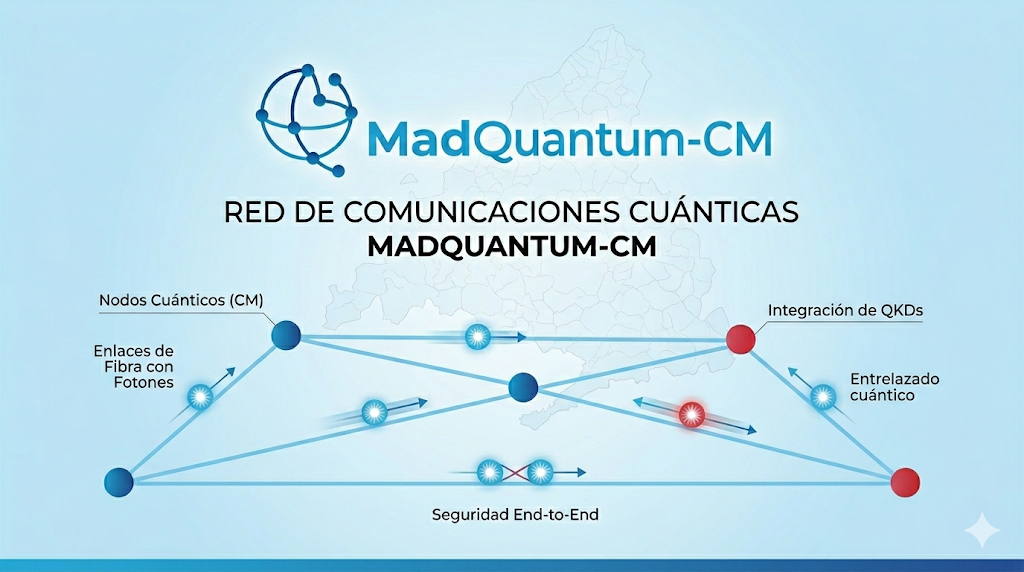
- The project, coordinated by researchers from UPM and involving IMDEA Networks and Universidad Carlos III de Madrid (UC3M), has delivered innovations in multiple quantum technologies, cryptography and satellites that bring Spain closer to the internet of the future.
- NEXTONIC has supported the activities of UC3M researchers by hosting a quantum communications testbed in its data centre.
Madrid, 27 May 2026 –MADQuantum-CM concluded after consolidating the Community of Madrid as a national and international benchmark in quantum technologies. The project has combined research in quantum cryptography, communications and processing with knowledge transfer initiatives and support for entrepreneurship.
The success of the initiative lies in the broad consortium of organisations involved, including the Spanish Centre of Metrology, Fundación Vithas, the IMDEA Networks and IMDEA Software institutes, the National Institute for Aerospace Technology, Universidad Autónoma de Madrid, Universidad Complutense de Madrid and Universidad Politécnica de Madrid (UPM). The latter coordinated the project in the region, which formed part of the Complementary Plan on Quantum Communication, also coordinated nationally by UPM together with ICFO.
Among its main achievements is the deployment of a quantum network across the region, together with significant advances in secure communications and the development of new applications for quantum computing. All of this has contributed to the creation of an environment that integrates research, industry and institutions to drive future quantum information networks, which will form the basis of the so-called quantum internet.
MadQCI, the quantum network connecting Madrid
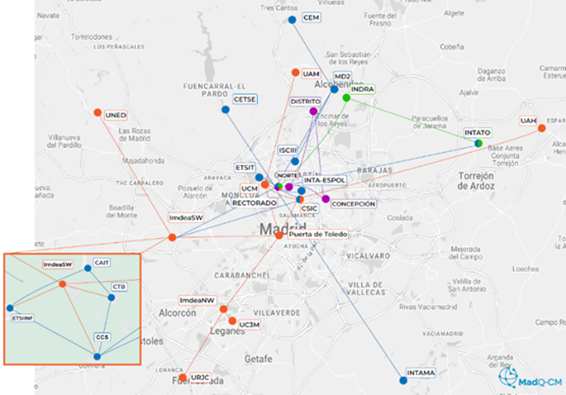
One of the project’s most important milestones has been the development of the MadQCI ecosystem, an interconnected quantum network infrastructure across the Madrid metropolitan area. Its objective is to provide quantum connectivity to all public universities in the region, research centres and other institutional sites, enabling the testing of quantum technology applications such as ultra-secure communications, cloud data protection and satellite connections.
In total, the infrastructure connects 30 locations through more than 700 kilometres of optical fibre and has been interconnected with experimental networks from technology companies such as Indra and Telefónica Innovación Digital, positioning Madrid as a strategic hub for quantum networking technologies and cybersecurity applications in Europe, in line with the EuroQCI initiative.
Technological advances with real impact
The project has achieved innovations throughout the entire quantum communications cycle, from physical devices to network management. Particularly noteworthy is the integration of quantum key distribution (QKD) systems, a technology that protects communications even against future quantum or disruptive technologies. QKD systems from all manufacturers have been integrated into the European ecosystem. Significant progress has also been made in satellite quantum links within the Q ANSER mission, including space-qualified polarisation tracking systems and complex network control tools.
In this regard, researchers from IMDEA Networks and UC3M developed an advanced testbed solution for secure end-to-end key distribution, combining QKD with cloud-native and SDN architectures, which was also hosted in NEXTONIC’s data centre. This resource is based on a virtualised and disaggregated key management layer deployed on Kubernetes clusters, enabling dynamic session establishment in complex scenarios involving multiple trusted-node hops. The solution has been evaluated by means of Quditto, which is a digital twin service for quantum communications networks for research and experimentation, also developed within the framework of the project. The tests have demonstrated key distribution, robustness against attacks and adverse conditions, and continuous, scalable and secure system operation, with real-time fault detection and QoS. This work was carried out by IMDEA Networks’ NETCOM Lab group in collaboration with the Department of Telematic Engineering at UC3Madrid and the NEXTONIC laboratory. In addition, active collaboration is ongoing with groups from the universities of Vigo and the Basque Country to assess deployments in their regional networks.
IMDEA Networks has also contributed in two additional lines of work in quantum technologies: security and quantum algorithms. The security work, carried out by the IAG and Cybersecurity groups, reviewed the state of the art in quantum network security, including threat models, attack types and proposed mitigations, with the aim of identifying future challenges linked to the integration of quantum and traditional networks, flawed assumptions, oversimplified models and interconnection issues between operators; the study will be published in the coming months.
In parallel, the Opportunistic Architectures group has worked on quantum consensus, designing and testing scalable quantum circuits on IBM hardware to bring quantum network components into a shared symmetric state, and on quantum annealing for Quadratic Knapsack problems, with new formulations consistently outperforming existing ones.
At the same time, the project has promoted advances in quantum information processing, with applications in computing, sensing and future distributed networks. For example, the Spanish Centre of Metrology has developed a quantum optical frequency standard with the potential to distribute ultra-precise and more secure timing signals through fibre-optic networks. In addition, algorithms and artificial intelligence-based techniques have been implemented to optimise quantum systems, with milestones such as the estimation of gravitational wave parameters through quantum computing and the enhancement of circuits on real hardware.
Through these achievements, MADQuantum-CM leaves behind an operational infrastructure, advanced technological capabilities and a collaborative network integrating research, industry and institutions. Madrid is therefore taking a decisive step towards secure communications and the future quantum internet in Spain and Europe.

About NEXTONIC
About NEXTONIC
«Where Networks Evolve»
NEXTONIC is the open innovation laboratory for the networks of the future, founded by Telefónica and IMDEA Networks. Originally established as 5TONIC in 2015, the laboratory was rebranded as NEXTONIC in October 2025 to reflect its expanded mission beyond 5G toward the development of 6G and emerging technologies. The laboratory serves as a collaborative space where industry and academia come together to test and validate technological components, generating knowledge and building an end-to-end vision of tomorrow’s networks. NEXTONIC drives joint projects, discussion forums, events, and conferences within a high-impact international environment. The main premises of NEXTONIC are co-located at IMDEA Networks Institute in Leganés, Madrid.